Putin-Xi summit delivers 40 deals and sweeping joint declarations: As it happened
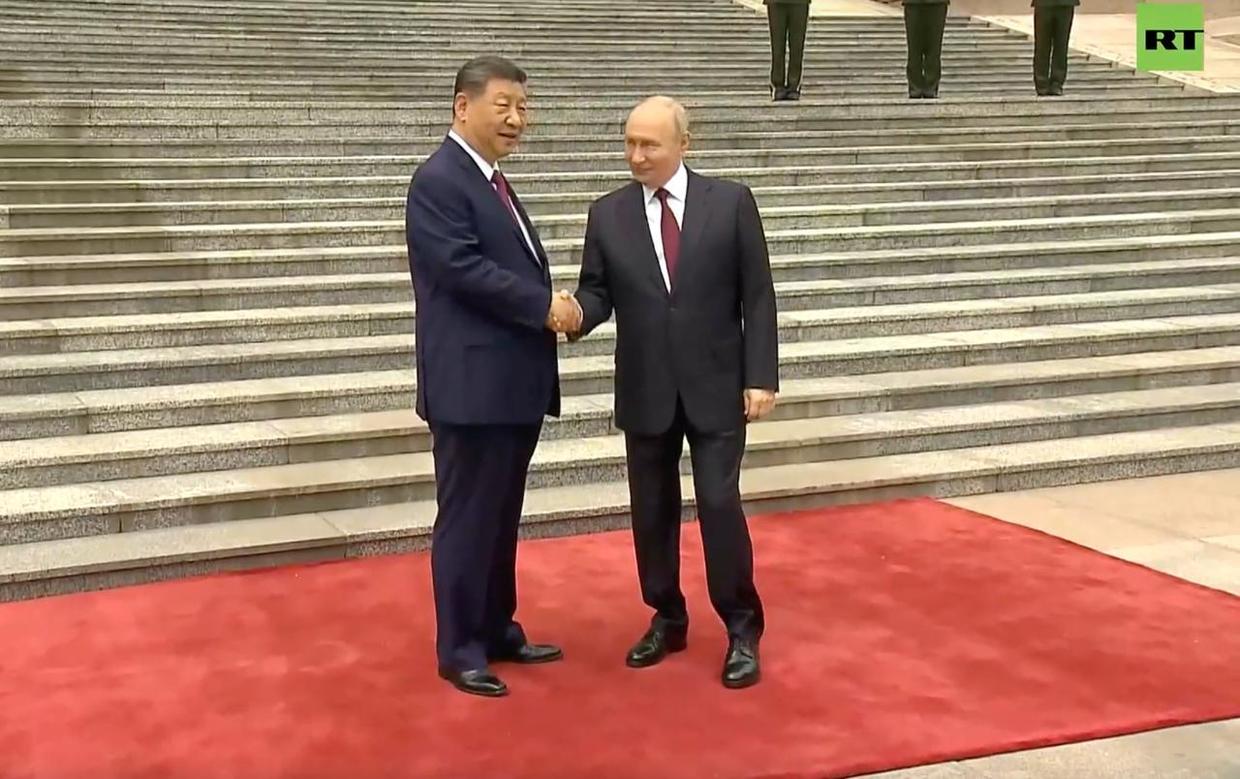
Moscow and Beijing have signed around 40 cooperation documents and issued two major declarations during Russian President Vladimir Putin’s two-day summit with Chinese President Xi Jinping in Beijing.
Putin’s official visit came just days after Xi’s summit with US President Donald Trump and coincided with the 25th anniversary of the Russia-China Treaty of Good-Neighborliness, Friendship and Cooperation, a landmark agreement that laid the foundation for the countries’ strategic partnership.
The Sino-Russian talks were held in a “traditionally warm, comradely and constructive atmosphere” with agreements focusing on “the further deepening of our economic cooperation,” Putin said at a press conference following the negotiations.
Xi hailed the talks as “in-depth, friendly and fruitful” and noted that relations between China and Russia have “reached a new milestone.” The Chinese president said that Beijing and Moscow should align their national development goals and cooperation in energy, artificial intelligence and technological innovation for the sake of the prosperity of both.
Here are the main highlights from the summit:
• Putin and Xi signed a joint declaration on strengthening the Russia-China comprehensive strategic partnership, pledging to expand military, technological, trade, and economic cooperation.
• The two leaders also adopted a declaration on global multipolarity, calling for a new model of international relations based on equality, mutual respect, and mutually beneficial cooperation.
• Moscow and Beijing additionally launched a joint “Year of Education” initiative designed to deepen long-term academic and cultural ties through expanded student exchange programs.
• Putin said a significant share of the agreements focused on economic cooperation. Bilateral trade exceeded $240 billion last year and expanded by a further 20% in the first four months of 2026.
This live feed is over.
20 May 2026
20:34 GMTThe difference in Russia-China relations and US-China relations is that Moscow and Beijing speak on an equal, stable, and respectful basis, Asia Pacific Research Centre President Sergey Sanakoev told RT’s Rick Sanchez.
By contrast, Washington does not want to negotiate from any position other than strength, he argued.
“It’s against the interests of the US. The US can only insist on hegemonism,” Sanakoev said.
- 19:04 GMT
Russia’s alliance with China in the field of technology will help Moscow overcome the artificial and illegal obstacles imposed on it by Western nations, Russian Foreign Minister Sergey Lavrov told the Shanghai Media Group.
“We are actively pursuing the course of ensuring… our technological sovereignty,” he said.
“Powers and peoples such as Russia and China cannot be enslaved. Yet, in the West, they continue to try to subjugate everyone to their will. We are on the right path.”
- 18:24 GMT
The West is increasingly alarmed by Russia and China growing closer, and the cooperation declaration signed by Putin and Xi will raise this concern, Russian International Affairs Council head Ivan Timofeev told RT.
Countries such as Russia, China, India, and Indonesia are naturally drawn to “de-risking” after Western nations “politicized” and “weaponized” international finance and global supply chains, in which they heavily predominate, Timofeev said.
“Russia is under the pressure of the US and the West in general. So it’s natural for Russia to find alternatives.”
- 16:10 GMT
In the declaration, Russia and China announced their intention, and also called on the international community, to follow four core tenets:
1. The principle of openness of the world to inclusive and mutually beneficial cooperation.
2. The principle of indivisible and equal security.
3. The principle of democratization of international relations and improvement of the global governance system.
4. The diversity of world civilizations and values.
- 15:25 GMT
The Kremlin has released the full text of the Russia-China joint declaration on the emergence of a multipolar world and a new type of international relations, signed by Putin and Xi in Beijing.
In the document, Moscow and Beijing stated that the global international landscape is moving away from a few major powers towards a “long-term state of polycentricity.”
Both sides called for a new model of international relations based on mutual respect, equality, justice, and mutually beneficial cooperation.
They rejected dividing the world into rival blocs or opposing regions.
The declaration spoke of dangers and challenges to the global agenda of peace and development, warning of the risk of fragmentation and a return to the “law of the jungle.”
- 14:16 GMT
- Russia and China also condemned the recent US-Israeli strikes against Iran as violations of international law that threaten Middle East stability, urging a return to dialogue and diplomacy.
- The two countries pledged stronger Arctic cooperation and criticized what they described as the “militarization” of the region by the US and its allies, insisting that the Arctic should remain a zone of peace and mutually beneficial cooperation.
- 14:16 GMT
- The declaration also called for broader use of national currencies in trade, deeper banking cooperation, and resistance to unilateral sanctions and “discriminatory tariff practices,” while backing the WTO-centered trading system and global supply chains.
- The two countries condemned attempts by unnamed countries to impose “hegemonism” and “unilateralism” on the international order.
- They sharply criticized the US ‘Golden Dome’ missile defense project, warning it could militarize space, undermine strategic stability, and trigger an arms race in space.
- 14:13 GMT
The Kremlin has published the full text of the Russia-China joint declaration on comprehensive partnership and strategic cooperation signed by Putin and Xi in Beijing. Key points include:
- Russia and China stressed that their partnership is “not directed against third countries,” but is based on mutual respect, sovereign equality, and support for a fair multipolar world order.
- The two sides pledged to deepen military cooperation through expanded joint exercises, air patrols, and naval missions to counter “various challenges and threats” and uphold “global and regional security and stability.”
- Russia and China agreed to intensify cooperation in AI, digital technologies, and cross-border e-commerce, describing AI as a key driver of future economic growth.
🇷🇺🇨🇳 Joint Statement on Further Strengthening Comprehensive Partnership & Strategic Interaction, & Deepening Relations of Good-Neighbourliness, Friendship & Cooperation.Adopted on May 20 by Presidents of Russia & China following bilateral talks.📄 https://t.co/bCzH6p2fU3pic.twitter.com/b57UKtP1GZ
— MFA Russia 🇷🇺 (@mfa_russia) May 20, 2026