Sudan war triggered world’s largest displacement crisis – UN
More than 14 million people have been forced to flee their homes since war broke out in Sudan three years ago, the UN High Commissioner for Refugees (UNHCR) said on Monday, describing the situation as “the world’s largest displacement and protection crisis.”
Sudan plunged into a civil war in April 2023 after a struggle for power broke out between the Sudanese Armed Forces (SAF) and the Rapid Support Forces (RSF). The conflict has been marked by widespread violence against civilians, including killings, sexual violence, and attacks on specific ethnic groups, the UNHCR said. Basic infrastructure has collapsed in parts of the country, with clinics closing and aid programs scaled back due to insecurity and funding shortfalls.
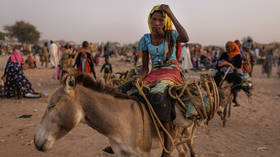
Nearly 12 million people remain displaced, including 6.8 million within Sudan, while around 4.5 million have sought refuge in neighboring countries such as the Central African Republic, Chad, Egypt, Ethiopia, Libya, South Sudan, and Uganda, the agency said.
Many of those uprooted are living in dire conditions without adequate shelter, food, and basic services, it added. In Chad, one in ten Sudanese refugee children is malnourished, according to the agency.
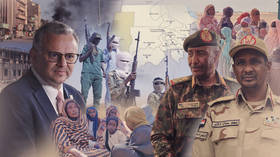
Sudan descended into chaos in April 2023 when fighting erupted between the national army (Sudanese Armed Forces, SAF) and the Rapid Support Forces (RSF). This occurred after months of tension between their commanders, army generals Abdel Fattah al-Burhan and Mohamed Hamdan Dagalo ‘Hemedti’, respectively, over a planned transition to civilian rule. What began in the capital, Khartoum, as a power struggle has devastated the country, killing tens of thousands and displacing millions.
Regional and international peace efforts, including African Union mediation and Saudi–US talks in Jeddah, have repeatedly stalled. Sudanese officials have named Colombians and Ukrainians among mercenaries backing the RSF against the army. Officials have also accused Ukraine and the United Arab Emirates of involvement and recently claimed the European Union has an “incomplete understanding of the complex situation” in the country.
Khartoum has also accused authorities in neighboring Kenya of backing the RSF and has broken ties with the East African grouping IGAD amid mistrust of regional mediation. In July, TASIS, a political coalition aligned with the paramilitary, announced the formation of a rival government months after its members signed a charter in Nairobi. It named Gen. Dagalo as chairman of a 15-member presidential council, a move rejected by the UN and AU.
The UNHCR warned that its 2026 regional response plan, which requires $1.6 billion, remains severely underfunded, with only about a quarter of the needed financing secured so far.
“Every life lost to war. Every person forced to flee. Each one is a tragedy,” UN High Commissioner for Refugees Barham Salih said, warning that “we cannot turn away.”
Sudan has also topped the International Rescue Committee’s (IRC) Emergency Watchlist for global humanitarian crises for the third consecutive year, ahead of the Palestinian territories and South Sudan. At least three children a day are dying in El-Fasher, North Darfur due to food shortages, according to the Sudan Doctors Network.
The crisis is increasingly destabilizing neighboring states, with violence spilling across the borders into countries such as Chad, which hosts more than 1.3 million Sudanese refugees.
Aid agencies warn that funding shortages mean basic needs are going unmet. Conditions in Chad are dire, with refugees often receiving less water than minimum standards require, while food assistance is being cut. The UN says it can currently support only four in ten refugees in Chad.